
What Is Artificial Intelligence? A Beginner’s Guide to AI in 2026
Meta Title
What Is Artificial Intelligence (AI)? Complete Beginner’s Guide 2026
Meta Description
Learn what Artificial Intelligence (AI) is, how it works, its types, benefits, applications, examples, and future impact. A complete beginner’s guide to AI in 2026.
What Is Artificial Intelligence? A Complete Beginner’s Guide
Artificial Intelligence (AI) is one of the most transformative technologies of the modern era. From virtual assistants like Siri and Alexa to self-driving cars and advanced chatbots such as ChatGPT, AI is changing how we live, work, learn, and interact with technology.
In 2026, AI has become an essential part of everyday life and business operations. Companies use AI to automate tasks, improve customer experiences, analyze data, and make smarter decisions. Individuals use AI tools to write content, learn new skills, create designs, and increase productivity.
But what exactly is Artificial Intelligence, and why is it so important?
This guide explains everything you need to know about AI, including how it works, its types, applications, benefits, challenges, and future trends.
What Is Artificial Intelligence (AI)?
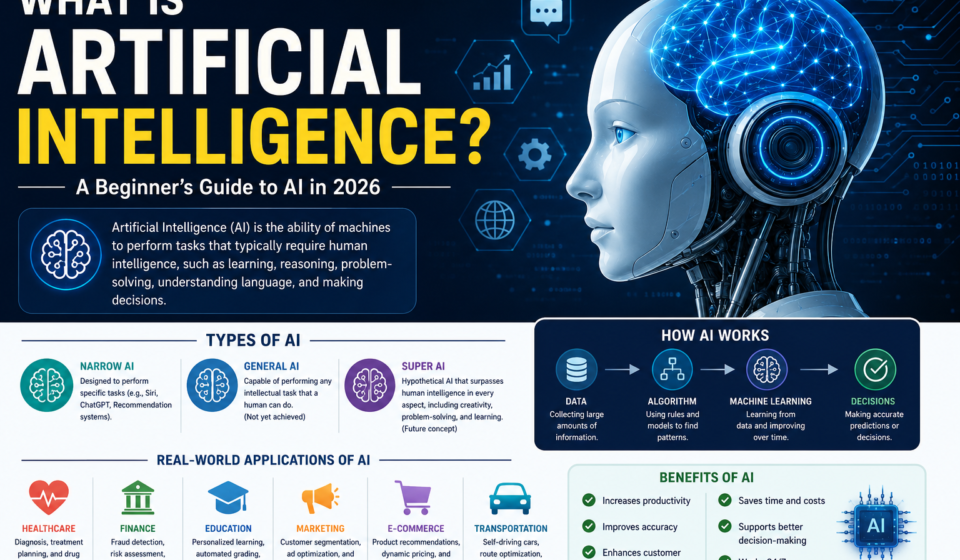
Artificial Intelligence (AI) refers to the ability of machines and computer systems to perform tasks that typically require human intelligence.
These tasks include:
- Learning from experience
- Understanding language
- Recognizing images and speech
- Solving problems
- Making decisions
- Predicting outcomes
- Generating content
In simple terms, AI enables computers to think, learn, and perform tasks in a way that mimics human intelligence.
For example:
- ChatGPT can answer questions and write content.
- Google Maps suggests the fastest route.
- Netflix recommends movies based on your preferences.
- Amazon recommends products you may want to buy.
All of these systems use Artificial Intelligence.
A Simple Definition of AI
Imagine teaching a child to identify a dog.
You show the child hundreds of pictures of dogs until they learn common patterns like:
- Four legs
- Tail
- Fur
- Barking
Eventually, the child can identify a dog they have never seen before.
AI works similarly.
Instead of being explicitly programmed for every situation, AI learns patterns from data and uses those patterns to make decisions.
How Does Artificial Intelligence Work?
AI works through a combination of:
1. Data
AI learns from large amounts of information called data.
Examples:
- Images
- Videos
- Text documents
- Audio recordings
- User behavior
The more quality data available, the better the AI system can learn.
2. Algorithms
Algorithms are instructions that tell AI how to learn from data.
These mathematical models identify patterns and relationships.
3. Machine Learning
Machine Learning is a branch of AI that enables systems to learn automatically from data without being explicitly programmed.
Examples:
- Spam email detection
- Product recommendations
- Fraud detection
4. Neural Networks
Neural networks are computer systems inspired by the human brain.
They help AI:
- Recognize images
- Understand speech
- Generate text
- Translate languages
Modern AI tools such as ChatGPT rely on advanced neural networks.
Types of Artificial Intelligence
AI can be classified into three major categories.
1. Narrow AI (Weak AI)
Narrow AI is designed to perform specific tasks.
Examples:
- Google Search
- Siri
- Alexa
- ChatGPT
- Recommendation systems
Most AI systems today fall into this category.
2. General AI (Strong AI)
General AI would be capable of performing any intellectual task that a human can perform.
Characteristics:
- Human-level reasoning
- Independent learning
- Adaptability
General AI does not yet exist.
3. Super AI
Super AI refers to a hypothetical system that surpasses human intelligence.
Capabilities could include:
- Scientific breakthroughs
- Complex decision-making
- Autonomous innovation
Currently, Super AI remains theoretical.
Key Technologies Behind AI
Several technologies power modern AI systems.
Machine Learning (ML)
Allows systems to learn from data.
Examples:
- Predictive analytics
- Fraud detection
- Recommendation engines
Deep Learning
A subset of machine learning using neural networks.
Examples:
- Image recognition
- Voice assistants
- Autonomous vehicles
Natural Language Processing (NLP)
Helps machines understand human language.
Examples:
- Chatbots
- Translation tools
- Voice assistants
Computer Vision
Allows machines to interpret images and videos.
Examples:
- Facial recognition
- Medical imaging
- Self-driving cars
Robotics
Combines AI with machines to perform physical tasks.
Examples:
- Warehouse robots
- Manufacturing robots
- Delivery robots
Benefits of Artificial Intelligence
1. Increased Productivity
AI automates repetitive tasks, allowing humans to focus on strategic work.
2. Better Decision-Making
AI analyzes large datasets and provides actionable insights.
3. Cost Reduction
Businesses save money through automation and efficiency improvements.
4. Improved Customer Experience
AI-powered chatbots and recommendation engines enhance customer satisfaction.
5. 24/7 Availability
AI systems can work continuously without breaks.
6. Enhanced Accuracy
AI reduces human errors in many processes.
Real-World Applications of AI
Healthcare
AI helps doctors diagnose diseases, analyze medical images, and personalize treatments.
Examples:
- Cancer detection
- Drug discovery
- Patient monitoring
Finance
Banks use AI for:
- Fraud detection
- Credit scoring
- Investment analysis
Education
AI supports:
- Personalized learning
- Automated grading
- Virtual tutors
Marketing
Marketers use AI for:
- Content generation
- Ad optimization
- Customer segmentation
E-commerce
AI powers:
- Product recommendations
- Dynamic pricing
- Customer support
Transportation
AI enables:
- Navigation systems
- Traffic prediction
- Autonomous vehicles
Examples of AI You Use Every Day
You may already use AI without realizing it.
Examples include:
- Google Search
- YouTube recommendations
- Netflix suggestions
- ChatGPT
- Siri
- Alexa
- Google Translate
- Instagram feed algorithms
- Spotify playlists
- Online shopping recommendations
Challenges and Risks of AI
While AI offers many benefits, it also presents challenges.
Job Displacement
Automation may replace certain repetitive jobs.
Privacy Concerns
AI systems often require large amounts of user data.
Bias and Fairness
Poor-quality training data can lead to biased outcomes.
Security Risks
AI systems can be targeted by cyberattacks.
Misinformation
AI-generated content can spread inaccurate information if not monitored.
The Future of Artificial Intelligence
The future of AI looks incredibly promising.
Expected developments include:
- Smarter AI assistants
- AI-powered healthcare breakthroughs
- Autonomous transportation
- Personalized education
- Advanced robotics
- AI agents capable of completing complex tasks
Experts believe AI will become as important as the internet in shaping the future economy.
Artificial Intelligence vs Machine Learning
| Feature | Artificial Intelligence | Machine Learning |
|---|---|---|
| Definition | Broad field of creating intelligent systems | Subset of AI |
| Goal | Mimic human intelligence | Learn from data |
| Scope | Larger | Smaller |
| Examples | ChatGPT, Robotics | Recommendation systems |
| Learning | May or may not learn | Learns automatically |
In simple terms:
All Machine Learning is AI, but not all AI is Machine Learning.
Frequently Asked Questions (FAQs)
What is Artificial Intelligence in simple words?
Artificial Intelligence is technology that enables computers and machines to perform tasks that normally require human intelligence.
Is ChatGPT an AI?
Yes. ChatGPT is an AI-powered conversational assistant that uses advanced language models to understand and generate text.
Can AI think like humans?
Current AI systems can simulate certain aspects of human intelligence but do not possess human consciousness or emotions.
What are the main types of AI?
The three main types are:
- Narrow AI
- General AI
- Super AI
Is AI good or bad?
AI is a tool. Its impact depends on how it is developed and used. It can provide tremendous benefits when used responsibly.
Will AI replace jobs?
AI may automate some jobs, but it will also create new opportunities and roles that require human creativity, judgment, and problem-solving.
Conclusion
Artificial Intelligence is transforming nearly every industry and aspect of modern life. From healthcare and education to business and entertainment, AI is helping people work smarter, solve complex problems, and unlock new opportunities.
As AI technology continues to evolve, understanding its fundamentals will become increasingly important. Whether you’re a student, professional, entrepreneur, or business owner, learning about AI today can help you prepare for the future and take advantage of one of the most powerful technologies ever created.